

Faith, Fried Chicken, and Folks Who Stress Us Out
On Sunday morning, we'll sing about loving our neighbors. By Sunday afternoon, we might be arguing with them on Facebook. We'll pray for the stranger, then avoid eye contact with the person who makes us uncomfortable. We'll thank Jesus for His grace while struggling to extend that same grace to the people sitting across from us.
The truth is most of us don't struggle to love the lovable people. We struggle to love the difficult ones. The ones who hurt us, who disagree with us, who we don't understand, or who we were taught to fear. And sometimes, if we're being honest, the hardest person to love is the one staring back at us in the mirror.
This blog is about that struggle. It's about faith, family, front porches, football, fried chicken, church hurt, hard conversations, and learning how to love our neighbors without pretending everything is simple. We'll talk about the things Southern culture gets beautifully right, and the things some of us had to unlearn with a whole lot of prayer, humility, and maybe a little counseling. We'll talk about racism, poverty, addiction, mental health, disability, sexuality, immigration, church culture, family patterns, and why "that's just how we were raised" may explain something without excusing it.
But this won't be about pointing fingers from a high horse. I don't own a high horse. I might have a stubborn mule somewhere on the family farm, but that's another conversation. The goal here isn't to win arguments, shame people, or act like becoming more like Jesus is easy. It's to ask better questions, listen longer, laugh when we can, repent when we need to, and to figure out what it looks like to hold truth and compassion in the same two hands. Because Jesus didn't tell us to love our neighbors only when they vote like us, talk like us, live like us, believe like us, or bring the right kind of potato salad to the potluck. He just said, "Love your neighbor." Simple to read. Much harder to live.
The older I get, the more convinced I become that the world doesn't need louder opinions, another culture war, or one more person telling everyone else why they're wrong. What it desperately needs is more people willing to love like Jesus. Not just in church or online, and not just when it's easy. Every day, neighbor, conversation, and uncomfortable moment. We’re going to talk about some things that may challenge us, make us laugh, and hit a little too close to home. But if we leave a little more humble, a little more compassionate, and a little more like Christ than we were yesterday, I’d call that a pretty good day on the front porch. God bless you, Darlin’, y’all come sit a while.
Talking About Bias: Seeing One Another Through Grace
“Red and yellow, black and white…” We sang it on Sunday, believing that every person is precious in His sight. The harder part has always been carrying that truth beyond the church doors and living on Monday as though every person truly bears the image of God. Bias teaches us to sort people into “us” and “them,” but grace reminds us that there is no “them,” only neighbors, families, stories, wounds, and souls God loves. Unity does not require us to erase our differences or pretend our history has not left scars. It asks us to face the truth with humility, listen without rushing to defend ourselves, repent where we have fallen short, and choose love strong enough to cross the lines fear has drawn. If the Church is to look like heaven, then we must become a people who make room at the table, honor the dignity in every face, and stand together, not because we are all the same, but because we all belong to the same God.
“There is neither Jew nor Greek, slave nor free, male nor female, for you are all one in Christ Jesus.”
Galatians 3:28
“But Momma Said Psychology Is the Devil”
Where I grew up, counseling was something “other people” needed. If you were anxious, you prayed harder. If you were depressed, you counted your blessings. If your marriage was falling apart, you smiled through it on Sunday morning. If your family had problems, you sure didn’t tell anybody outside the family. Therapy? That was for “crazy people.”
Looking back, I don’t think people were trying to reject science. I think they were trying to protect their faith. The problem is, somewhere along the way, many Christians were taught they had to choose between trusting God and understanding the human mind. I don’t believe that’s the choice Jesus asks us to make. To see why faith and counseling do not have to compete, we first need a plainspoken answer to a basic question: what exactly is psychology? Or, as our great-grandfather’s would’ve said:
What in Tarnation Is Psychology?
Now hold your horses. Before anybody starts worrying that this book is about to replace Grandma’s Bible with a therapist’s couch, let’s get something straight. Psychology is not a religion. It’s the scientific study of how people think, feel, learn, behave, and relate to one another. It asks questions like:
Why do we do the things we do?
Why do some people bounce back after hardship while others struggle for years?
Why do our childhood experiences still affect us as adults?
Why do fear, shame, love, grief, and hope change the way we make decisions?
Psychology seeks to understand the human mind and behavior through observation, research, and evidence. Sometimes it gets things right. Sometimes theories evolve as we learn more. That’s how science works. Scripture, on the other hand, answers questions psychology was never designed to answer. Who created us? Why are we here? What is sin? What is grace? Who is Jesus? How are we reconciled to God? Those aren’t scientific questions. They’re spiritual ones. As both a Christian and a counselor, I don’t see Scripture and psychology as enemies fighting over who’s right. I see them as answering different kinds of questions.
If your truck won’t start, your mechanic can probably tell you what is wrong. Your pastor can remind you not to lose your faith over it. Both can be helpful. Psychology can explain why trauma changes the brain. Scripture tells us that God is close to the brokenhearted. Psychology can teach healthy communication skills. Jesus shows us what perfect love looks like. Psychology can identify unhealthy relationship patterns. Scripture teaches us the kind of character we’re called to cultivate. “Psychology is a flashlight, not a compass. It can illuminate how people think and behave, but Scripture remains the compass that directs how Christians ought to live.” One explains. The other transforms. When psychology agrees with biblical truth, I welcome it. When it contradicts Scripture, Scripture wins.
Throughout this blog you’ll hear me talk about nervous systems, attachment, addiction, trauma, cognitive distortions, emotional regulation, and all sorts of fifty-dollar counseling words. Don’t worry, y’all; I promise to translate them into plain Southern English. Sometimes understanding why people behave the way they do helps us obey Jesus’ command to love them a little better. Psychology doesn’t replace the Holy Spirit, but it can help us recognize the habits, hurts, and assumptions that shape how we see ourselves and one another; including the person staring back at us in the mirror. That matters especially when those assumptions involve people who seem different from us. So, with sweet tea in hand and grace at the center, let’s begin with one of the hardest things to notice in ourselves: bias.
Seeing a shrink doesn’t shrink your faith
And contrary to popular belief, it won’t “brainwarsh” you either. (Yes, I spelled that with an “r.” If you’re from the South, you probably didn’t even notice.) Somewhere along the way, many of us were taught that counseling and Christianity were on opposite sides of the fence. If you trusted a therapist, you must not trust God enough. If you studied psychology, you were just one semester away from becoming an atheist. Bless our hearts.
The truth is, seeing a counselor doesn’t replace prayer any more than seeing a cardiologist replaces trusting God with your heart. God often works through people: pastors, physicians, teachers, counselors, and yes, even psychologists. A therapist can’t forgive your sins. A psychologist can’t save your soul. But they can help you understand why you keep reacting the way you do, recognize unhealthy patterns, heal from trauma, improve your relationships, and learn healthier ways of thinking and living. That doesn’t shrink your faith. It might just strengthen it. After all, if all truth is God’s truth, we shouldn’t be afraid to learn more about the people He created.
Jesus Didn’t Create Us to Reject Us
I grew up in a small Southern town in what I lovingly call L.A., Lower Arkansas, where everyone knew everyone, or at least something about them, and if they didn’t, they might make it up. Alan Jackson played through grandma’s speakers, and if you got in trouble at school, your momma knew before you got home. We loved Jesus. The harder question was whether we loved like Jesus. My questions were rarely popular. Too often I heard, “We don’t ask questions,” “I’ll pray for you,” or my personal favorite, “God bless you, Darlin’.”
One of my earliest memories of difference happened in second grade, when our teacher said a new student was joining our class and that he “looked different,” but we shouldn’t treat him differently. At seven, I didn’t understand why that needed to be said. I was confused not by him, but by why adults prepared us to see difference before teaching us to see people. We weren’t born believing certain children were “other.” We learned it quietly, through tones, warnings, and fears adults carried.
Years later, a friend mentioned she had a crush on another girl. After she left the locker room, several girls said they weren’t comfortable changing around her anymore. At twelve, I couldn’t understand why who someone liked made them unworthy of dignity, and I learned that doing what you believe is right can cost your social acceptance.
By high school, the injustice around me had become too loud to ignore, so I transferred to a school in a bigger city, hoping for something more fair and welcoming. Instead, I learned that changing schools doesn’t eliminate injustice; it just changes what it looks like. At a gas station, a cashier watched my friend’s every step and barely looked at me while she handed me my change. Prejudice doesn’t belong to one color, town, denomination, or political party. It is a human problem.
Years later, I met a father accused of medical neglect because his son hadn’t received dental care. On paper, it looked simple; in person, it wasn’t. He wasn’t careless. He was terrified. His son was a U.S. citizen; he wasn’t. He feared that taking his child to the dentist might expose his immigration status and lead to separation. What looked like avoidance was a father trying to protect the one relationship he couldn’t bear to lose.
Fear can look like neglect when no one asks what a person is afraid of. Poverty, immigration status, language barriers, trauma, shame, and isolation can turn ordinary systems into places that feel dangerous. Scripture tells us to love the foreigner as ourselves and speak up for those who cannot speak for themselves. That doesn’t mean ignoring a child’s needs. It means refusing to reduce a frightened parent to a label.
Not long ago, I almost peeled a simple “Ally” sticker off my laptop because I became aware of who might be watching. For a split second, I wanted to hide it. Then God stopped me with a question: You can hide your laptop. What about the people who can’t hide who they are?
An LGBTQ+ person doesn’t get to zip themselves into a backpack every time they fear rejection, judgment, ridicule, or exclusion. Many have spent years hiding parts of themselves just to feel safe. I wasn’t convicted for supporting LGBTQ+ people. I was convicted because fear had spoken louder than love. That is where moral juxtaposition shows up: the tension between conviction and compassion, truth and grace, holiness and humility.
Jesus never sacrificed truth to love, nor love to truth. He moved toward the people everyone else moved away from.
Respect shouldn’t end where consequences begin. If the only time we use someone’s name or pronouns correctly is when a policy requires it, that is not respect; it is compliance. Love doesn’t wait for rules, permission, or proof that someone has earned dignity.
We also need to remember that biblical terminology is not the same as the terminology used today to oppress LGBTQ+ individuals, immigrants, and other marginalized groups:
Passages such as Leviticus 18:22; Leviticus 20:13; Romans 1; 1 Corinthians 6; and 1 Timothy 1 are often used to shame or exclude LGBTQ+ individuals today, but in context they addressed ritual purity laws, temple prostitution, idolatrous sexual practices, power-imbalanced relationships, and exploitation, not modern concepts of sexual orientation, gender identity, or loving, consensual same-sex relationships.
Deuteronomy 28:43 is sometimes misused to justify fear or exclusion of immigrants, but it was not a command to mistreat foreigners. It was a covenant warning about what would happen if Israel abandoned justice and compassion, while the Torah repeatedly commands God’s people to protect, welcome, and love the foreigner.
When we force ancient texts into modern categories, we risk using Scripture to harm people Jesus would have moved toward. The Bible was not written with today’s sociological, psychological, or identity-based language in mind, and modern oppression often relies on terminology the biblical authors never used or meant.
Regardless of where someone lands on Scripture’s complex passages about sexuality or gender, one truth remains: every person is made in God’s image, loved by God, invited to Christ, and every follower of Jesus is commanded to love. If my theology gives me permission to dehumanize someone, I have misunderstood the heart of Christ.
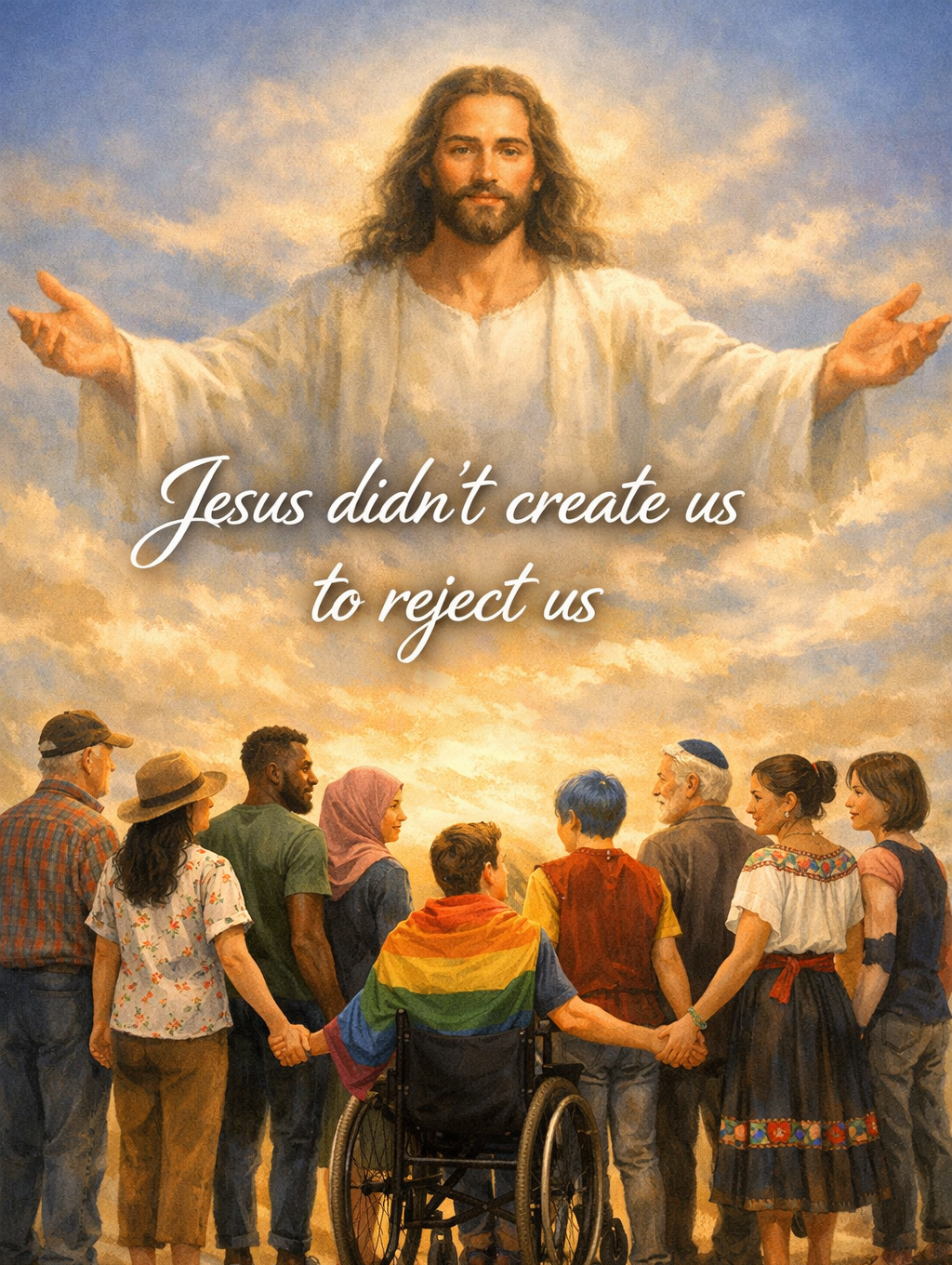
The greatest transformation God worked in me wasn’t changing a sticker. It was changing my heart. Following Jesus has never been about finding people worthy of love. It is about remembering that none of us were, and He loved us anyway. Love your neighbor as yourself. Simple to read, much harder to live. But God didn’t create us to reject us. He created us to reconcile us to Himself and to one another.
Lord, replace our fear with perfect love. Teach us to see every person through Your eyes. And may the world recognize us, not because we won every argument, but because we loved like Jesus. Amen.

Family Trees Grow Fruit
“Children are to be seen, not heard.” Many of us grew up hearing some version of that sentence. Maybe nobody said it out loud, but the message still settled into the walls of the house: do not ask too many questions, do not challenge an adult, do not talk about what happens at home, and do not make the family uncomfortable with your feelings. Silence was called respect. Fear was called obedience. Survival was called strength.
But children do not stop having needs simply because adults refuse to hear them. They learn to bury those needs. The unheard child may become the adult who apologizes for taking up space, mistakes control for love, avoids conflict at any cost, or explodes because nobody ever taught them how to speak before anger took over. What goes unspoken does not disappear. It often travels down the family line wearing a different outfit.
Every Family Tree Bears Fruit
Generational trauma is the pain, fear, beliefs, and coping patterns that move from one generation to the next. A grandmother who survived scarcity may raise children who fear there will never be enough. A father who was punished for crying may teach his son to swallow grief. A mother who learned to keep the peace may teach her daughter to confuse people pleasing with love. These patterns are not always passed down through cruelty. Sometimes they are handed to us by people who loved us deeply but could only teach what they had learned.
Family trees also grow good fruit. We inherit prayers whispered over sleeping children, recipes that gather everybody around one table, songs sung through hardship, humor that keeps sorrow from having the final word, and faith that survived seasons it should not have survived. Generational blessing is real. Courage can be inherited. Compassion can be practiced until it becomes a family language. One person’s healing can become shelter for children who have not even been born yet.
Breaking a Cycle Is Holy Work
Breaking a cycle does not mean declaring war on your family. It means refusing to let pain keep writing the same chapter. It can look like learning to name emotions instead of shaming them, apologizing to your children when you are wrong, choosing counseling, refusing to protect abuse with secrecy, or creating a home where questions are welcomed. It is noticing the fruit, tracing it back to the root, and deciding what will be pruned and what will be nourished.

Honor Thy Father and Mother, With Boundaries
“Honor your father and your mother” does not mean surrender your voice, deny what happened, or remain available for repeated harm. Honor is not pretending dysfunction is healthy. It is not unlimited access, automatic agreement, or silence in the face of sin. Sometimes honor looks like speaking gently. Sometimes it looks like forgiving without returning to the same unsafe relationship. Sometimes it looks like saying, “I love you, and I will not allow you to speak to me that way.” A boundary is not revenge. It is a clear statement of what love, truth, and safety require.
Healthy boundaries may disappoint people who benefited from your lack of them. That does not make the boundary dishonorable. You can pray for someone and still limit contact. You can forgive and still require accountability. You can be grateful for what your parents gave you and honest about what they could not. Grace does not ask us to call harm good. Grace gives us the courage to tell the truth without becoming cruel.
Grow Different Fruit
You did not choose the soil you were planted in, but healing can change what grows through you. Let the next generation inherit more than your survival. Let them inherit language for their feelings, permission to ask for help, apologies without excuses, faith without fear, and love that does not demand they disappear. Let them know children are not merely to be seen. They are to be heard, protected, guided, and cherished.
Perhaps that is how cycles finally break. Not through pretending the tree was never wounded, but through tending its roots with truth, grace, wisdom, and courage. In Christ, our history can explain us without imprisoning us. We can honor where we came from while choosing where we are going. We can keep the good fruit, lay down what has poisoned the branches, and become the beginning of a healthier family story.
“The fruit of the Spirit is love, joy, peace, patience, kindness, goodness, faithfulness, gentleness and self-control.”
Galatians 5:22–23